
Guide · For facility managers and IPC leads
Environmental and Surface Cleaning in Aged Care
A practical guide to surface cleaning in aged care: which surfaces matter most, how often to clean them, how to run clean and dirty zones, how to deal with spills and body fluids, and how to choose products that are safe for residents as well as effective against germs.
In this guide
Environmental cleaning is the part of infection control that happens on surfaces rather than on hands. In an aged care home it covers every bed rail, tap, table and floor that residents, staff and visitors touch in a day, and it is one of the few defences that works around the clock. This guide is written for the people who plan and check that work: facility managers, IPC leads and the cleaning staff who carry it out. If you are looking for cleaning help rather than a method, see our aged care cleaning Melbourne services.
The short answer
What is environmental and surface cleaning in aged care?
Environmental and surface cleaning in aged care is the routine removal of dirt and germs from the rooms, furniture, fittings and equipment around residents. It relies mainly on detergent and water, adds a disinfectant when an infection is known or suspected, and cleans the surfaces people touch most far more often than the rest.
The Australian Guidelines for the Prevention and Control of Infection in Healthcare set the baseline most homes follow. Their message is simpler than many people expect: clean surfaces with detergent, clean frequently touched surfaces at least daily, and clean anything again whenever it is visibly dirty. Disinfection is a second step, used for a reason, not a daily habit.
The benefits of surface cleaning in aged care are easy to underrate because nothing visible happens when it works. Residents do not catch the norovirus left on a lift button, the chair arm does not pass on a cold, and the next resident moves into a room that no longer carries anything from the last one. Surface cleaning also keeps floors safe underfoot and rooms pleasant to live in, which matters as much to residents as the germs they cannot see.
- Cleaning
- Removing dirt and most germs with detergent, water and friction. Always the first step.
- Disinfection
- Killing the germs left behind with a registered product, applied to a surface that is already clean.
- High-touch surface
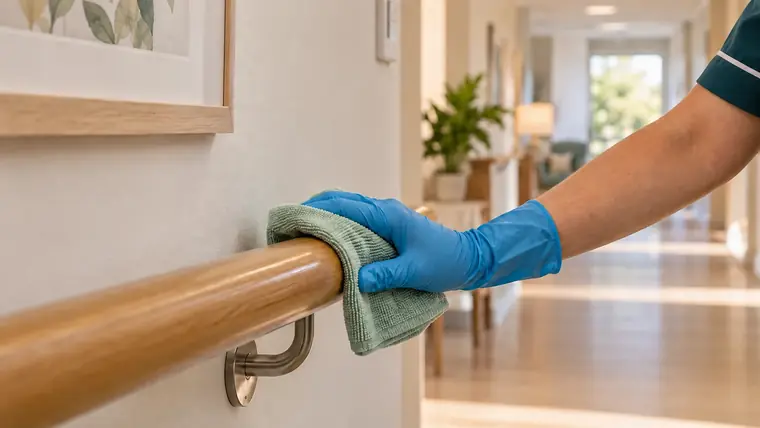
- Anything touched by many hands many times a day: rails, buttons, handles, taps, remotes and call bells.
- Contact time
- The number of minutes a product needs to sit wet before it has done its job, printed on every label.
Step by step
How is environmental cleaning done in aged care, step by step?
Environmental cleaning in aged care is done in a fixed order: plan the frequency for each surface, keep clean and dirty zones apart, work from clean areas to dirty ones and high surfaces to low, use detergent first, and treat every spill straight away with its own set of steps and equipment.
How often each surface should be cleaned
Frequency should follow risk. The table below is a typical starting point for a residential home on a normal day; your IPC lead may raise any line, and an outbreak raises most of them.
| Surface | Routine day | Also clean |
|---|---|---|
| Handrails, lift buttons, door handles | At least daily, often twice | When visibly soiled |
| Bed rails, call bells, over-bed tables | Daily | After each meal tray |
| Ensuite taps, rails, toilet, shower chair | Daily | After any spill or accident |
| Dining tables and chairs | After every meal | After activities held there |
| Floors in rooms and corridors | Daily | Straight away after a spill |
| Shared equipment, such as hoists and wheelchairs | After each resident | Before storage |
What is a clean zone in aged care?
A clean zone in aged care is an area where clean supplies and food are handled and where nothing contaminated should ever arrive, such as a linen store, a servery or the clean side of a utility room. Dirty or contaminated zones are where used items and waste go: pan rooms, sluices, dirty linen skips and bathrooms. Enforcing clean and contaminated zones in aged care comes down to three habits that are easy to check on a walk-round.
Colour-coded cloths, mops and buckets stay in their own zone, and trolleys carry clean and used items in sealed, separate sections.
Staff work from clean to dirty and never return from a pan room to a linen store without removing gloves and washing hands.
Clean and dirty rooms are signed at the door, so new or agency staff do not have to guess which is which.
Cloths, mops and how to handle them
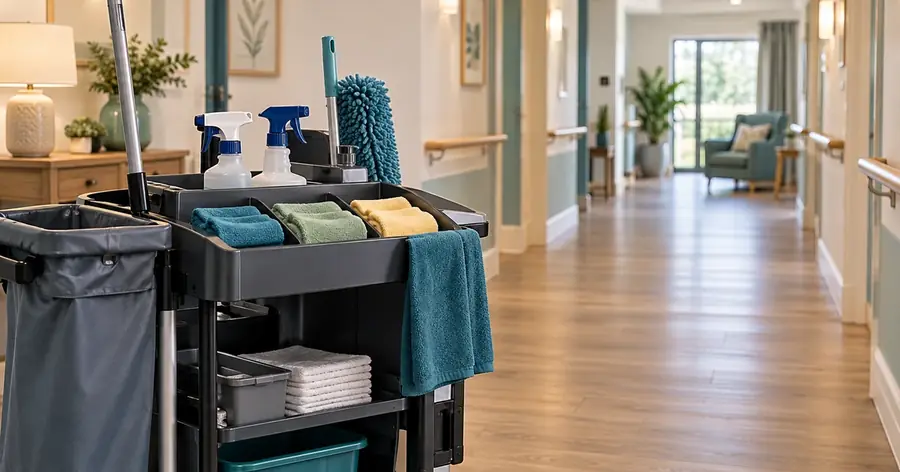
Microfibre cloths pick up far more dirt than cotton ones, but only if they are folded and turned. Fold each cloth into quarters to give eight clean faces, use one face per surface, and put the cloth in the used bag once every face has been used rather than rinsing it in the same bucket. Mop heads are changed for each room in wet areas and at least for each wing elsewhere, and everything goes through a hot wash and a full dry before it is used again. A damp cloth left in a bucket overnight is a breeding ground, not a spare.
Cleaning a room between residents
When a resident moves out or passes away, the room needs a full clean before anyone else moves in, sometimes called a terminal clean. Everything is cleaned, not only what looks used: inside wardrobes and drawers, the bed frame and mattress cover, curtains or blinds, light fittings, the ensuite from ceiling to floor and every fixture. If the previous resident had a known infection, the clean follows your IPC lead's instructions and usually adds a disinfectant step and a change of privacy curtains. Families often visit the room soon after, so it is worth doing this carefully and quietly.
How to clean up a spillage in aged care
Spills of blood, vomit, urine or faeces need to be dealt with at once, both to stop germs spreading and because a wet floor is a falls risk. Knowing how to clean up an infectious spill in aged care is part of every cleaner's induction, and every wing should have a spill kit within reach.
- Make it safe. Put out a wet floor sign and keep residents away from the area.
- Protect yourself. Wash hands, then put on gloves, an apron and, for splashes, eye protection.
- Confine and contain. Cover the spill with disposable absorbent material from the spill kit.
- Remove the matter. Lift the absorbed material into a waste bag and discard it as your site's waste plan directs.
- Clean, then disinfect. Clean with detergent and water, then apply a chlorine-based or registered disinfectant for its full contact time.
- Finish and record. Dry the floor, dispose of PPE, wash hands and log the spill and where it happened.
These steps follow the spill guidance in the Australian Guidelines for the Prevention and Control of Infection in Healthcare. When you mix a chlorine solution from concentrate, the Victorian Department of Health's chlorine dilutions calculator gives the right strength for the job.
Common mistakes
What are the most common environmental cleaning mistakes?
The most common mistakes are skipping the detergent step, wiping disinfectant off before its contact time, using one cloth across several rooms, cleaning dirty areas before clean ones, and leaving floors wet where residents walk. Each one is quick to fix once someone watches a shift and notices it.
- Disinfectant on a dirty surfaceGrime shields germs from the product. Clean first, then disinfect if you need to.
- Wiping it straight offA spray-and-wipe in two seconds does little. Leave it wet for the time on the label.
- One cloth, many roomsA cloth carried from room to room spreads germs faster than it removes them.
- Dirty areas firstCleaning a toilet before a bedside table moves the problem instead of removing it.
- Forgetting the small thingsRemotes, call bells, walking frames and tablet screens are touched constantly and missed often.
- Mixing productsBleach mixed with other cleaners can give off harmful gas. Use one product at a time.
- Wet floors at busy timesMopping a corridor just before lunch invites falls. Dry-mop then, and wet-mop later.
- No recordIf it is not written down, nobody can show it was done, and nobody can spot the gaps.
Risks of using cleaning products and sanitiser in aged care
Products that are harmless in an office can hurt a frail resident. Strong fragrances and aerosol sprays irritate lungs, especially for people with asthma or COPD. Residue from the wrong floor product can leave tiles slippery. Alcohol hand sanitiser and brightly coloured bottles can be mistaken for a drink by a resident living with dementia, so products belong on locked trolleys or in locked stores, never on a sink edge.
Choose the mildest product that does the job, keep a safety data sheet for each one, and check disinfectant choices against your home's IPC guidance. The Commission's environmental cleaning and infection prevention and control resources, including The Aged Care Infection Prevention and Control Guide, are a sound place to start.
Bringing in help
When should an aged care home bring in specialist cleaners?
An aged care home should bring in specialist cleaners when its own team cannot keep up with the frequencies it needs, when an outbreak calls for extra hours at short notice, when rooms need a full clean between residents, or when records keep showing the same gaps on spot checks.
Often fine to keep in-house
- Small spills during care, handled by care staff with a spill kit
- Wiping over-bed tables after meals
- Cleaning shared equipment between residents
Worth bringing in help for
- Daily cleaning of rooms, ensuites and common areas across several wings
- Outbreak step-ups needing more cleaner hours the same day
- A full clean of a room before a new resident moves in
- Night floor care and kitchen deep cleans
Whoever does the work, the method in this guide should not change. If you would like a team that already works this way, our aged care facility cleaning service covers rooms, common areas, outbreaks and records across Melbourne, and you can get a quote after a free walk-through.
FAQ